
 Reviewed by
Your WooCommerce product titles were written to describe your products on your website. Google Shopping titles have a different job: they need to match what shoppers type into the search bar, communicate the product clearly in a small ad unit, and convince someone to click your listing over the ones next to it.
Most WooCommerce stores submit their product names directly to Google Shopping without any changes. The result: titles like “Blue Dress,” “Running Shoe,” or “Coffee Mug” — generic names that don’t match specific search queries, don’t stand out in the Shopping tab, and leave significant CTR and conversion on the table.
This guide covers practical WooCommerce product title optimization for Google Shopping, including the formula that works by product category, the common mistakes that hurt performance, and how to apply improvements at scale using AdTribes feed rules without editing each product manually.
Why Product Titles Are Your Most Important Feed Field
In Google Shopping, your product title does three jobs simultaneously:
1. Query matching
Google uses your product title as one of the key signals for understanding what you’re selling and matching your products to relevant searches. The closer your title aligns with the words shoppers use, the easier it is for Google to understand when your product may be relevant. In Shopping campaigns, strong product data does much of the heavy lifting, and the title is one of the most important parts of that data.
2. Ad display
Your title is the first text a shopper reads in a Shopping ad. Google truncates long titles — typically showing around 70 characters in the Shopping tab and fewer on mobile. The most important information needs to be front-loaded.
3. Relevance and click potential
Your title helps Google understand what you’re selling and helps shoppers quickly decide whether your product matches what they need. The clearer and more specific your title is, the easier it is for your listing to appear in relevant searches and communicate value at a glance.
Google’s title guidance recommends using the available space thoughtfully, putting the most important details first, and including distinguishing attributes such as brand, size, color, or product type when they’re relevant. In practice, that usually leads to clearer listings and better-qualified clicks.
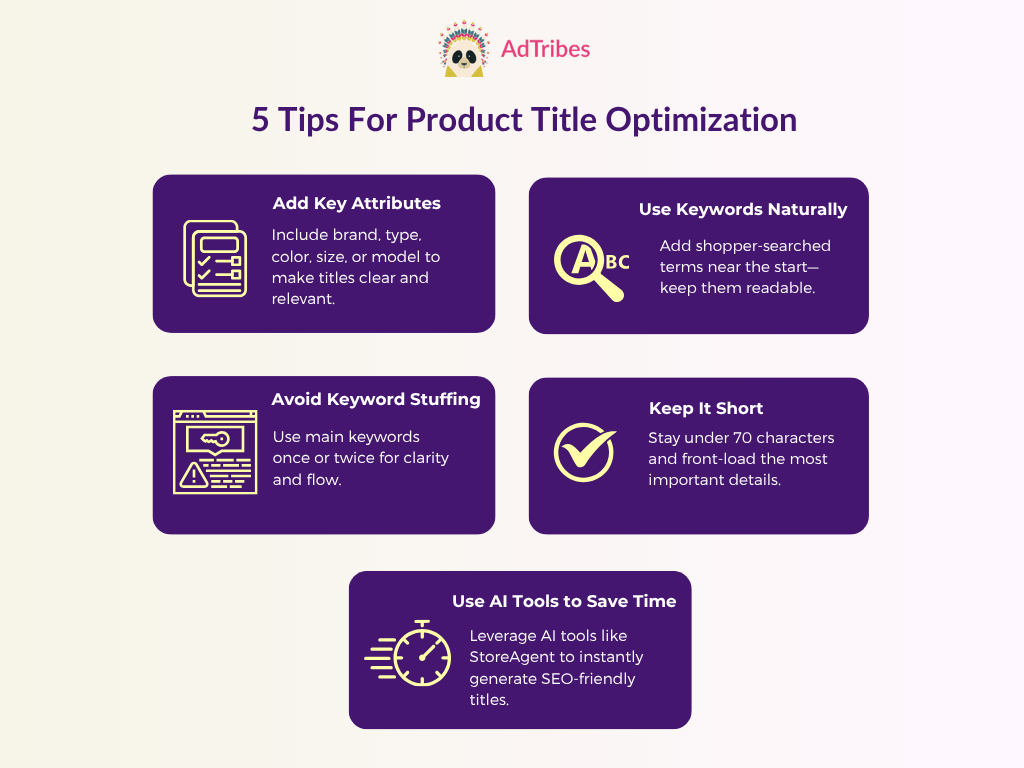
The Product Title Formula
The formula that consistently produces high-performing Google Shopping titles:
Brand + Product Type + Key Attributes
This structure works because it front-loads the information shoppers scan for: whose product it is, what type of product it is, and the specific variant or feature that makes it the right choice for them.
Key attributes vary by product type but typically include some combination of:
- Color
- Size / dimensions
- Material
- Gender (for apparel)
- Model number (for electronics)
- Key feature or benefit
Character limit: Google supports up to 150 characters for product titles, but shoppers usually see only the first 70 or fewer characters depending on screen size. That’s why it’s best to front-load your most important details first, then use the remaining space for relevant attributes such as brand, size, color, material, or model.
Examples applying the formula:
| Before (typical WooCommerce title) | After (optimized) |
|---|---|
| “Running Shorts” | “Nike Men’s Dri-FIT Running Shorts — Black, Size M” |
| “Coffee Table” | “IKEA LACK Coffee Table — Black-Brown, 90×55cm” |
| “Face Serum” | “The Ordinary Niacinamide 10% + Zinc 1% Serum — 30ml” |
| “Leather Wallet” | “Fossil Men’s Leather Bifold Wallet — Brown, RFID Blocking” |
| “Dog Bed” | “PetFusion Ultimate Dog Bed — Large, Grey, Memory Foam” |
Notice how each optimized title immediately tells Google (and the shopper) exactly what the product is, who it’s for, and what makes it specific. A search for “men’s black nike running shorts medium” would match the optimized title — it would never match “Running Shorts.”
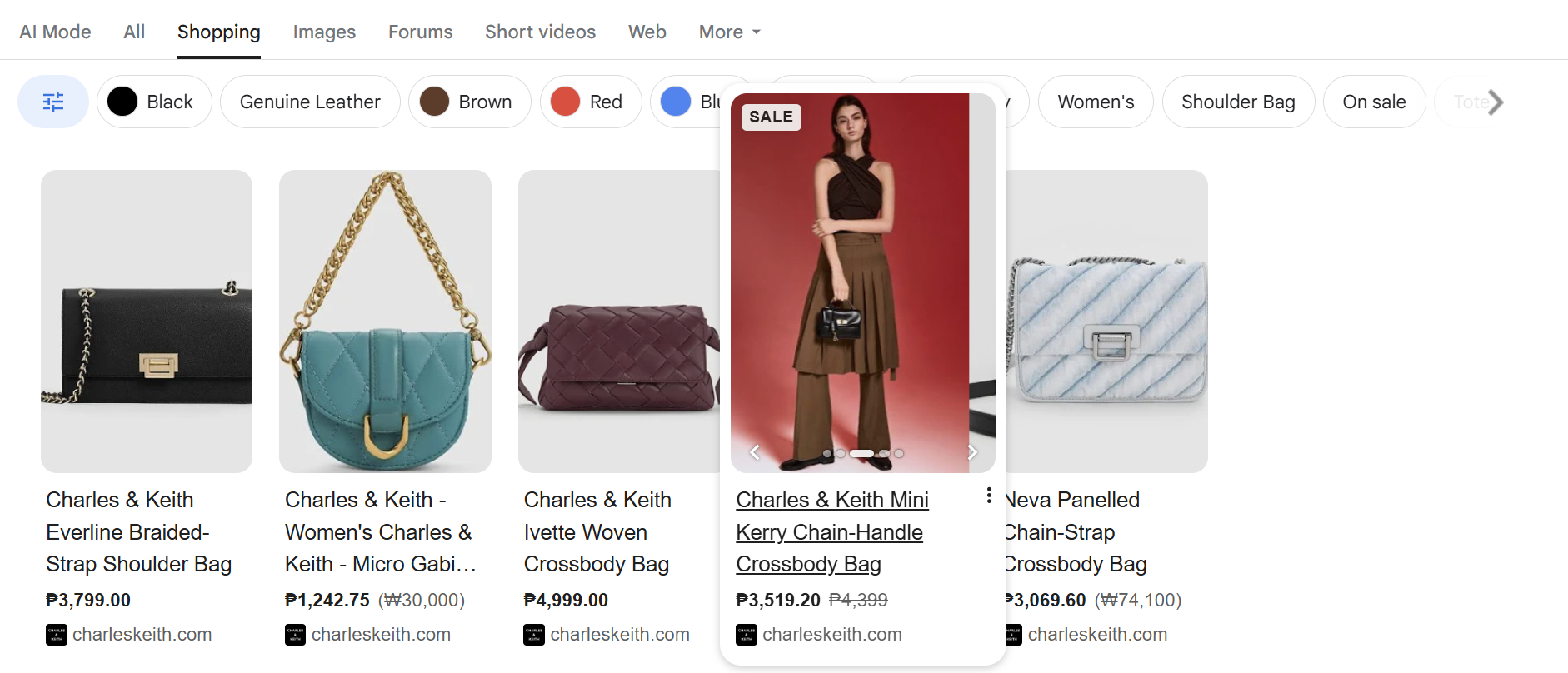
Title Optimization By Product Category
The formula stays the same, but the key attributes that matter most vary by product type. Here’s the priority order for the most common WooCommerce categories.
Apparel and footwear
Priority attributes: Brand → Gender → Product Type → Color → Size → Material
- “Levi’s Women’s 501 Original Fit Jeans — Dark Wash, W28 L30”
- “Adidas Men’s Ultraboost 22 Running Shoe — White/Core Black, Size 10”
- “Patagonia Women’s Down Sweater Jacket — Navy Blue, XS”
For apparel, Google has specific requirements: gender, age group, color, and size are all official feed attributes — map these explicitly in AdTribes rather than stuffing them only into the title.
Electronics and tech
Priority attributes: Brand → Product Type → Model Number → Key Spec → Color/Finish
- “Apple AirPods Pro (2nd Gen) — Active Noise Cancelling, USB-C, White”
- “Samsung 65″ QLED 4K Smart TV — QN65Q80C, 120Hz, 2024”
- “Logitech MX Master 3S Wireless Mouse — Graphite, 8000 DPI”
Model numbers matter significantly in electronics — shoppers often search by specific model. Include the model in the title even if it feels redundant.
Home and garden
Priority attributes: Brand → Product Type → Material → Color → Size/Dimensions
- “IKEA KALLAX Shelf Unit — White, 4 Compartments, 77×77cm”
- “Lodge Cast Iron Skillet — 12 Inch, Pre-Seasoned, Black”
- “Yankee Candle Large Jar — Clean Cotton, 623g, 150 Hours”
Beauty and personal care
Priority attributes: Brand → Product Type → Key Ingredient/Benefit → Size → Shade (if applicable)
- “CeraVe Moisturising Cream — 340ml, Dry to Very Dry Skin”
- “Charlotte Tilbury Pillow Talk Lipstick — Matte, Medium Nude Pink”
- “Olaplex No.3 Hair Perfector — 100ml, Bond Strengthening Treatment”
Handmade and unique products
For products without a brand (or where your store name is the brand), front-load the most descriptive attribute:
Priority attributes: Product Type → Material → Key Feature → Dimensions/Size
- “Handmade Leather Journal — A5 Brown Distressed, 192 Lined Pages”
- “Macramé Wall Hanging — Natural Cotton, 60×90cm, Boho Decor”
- “Ceramic Pour Over Coffee Set — Matte White, 600ml Carafe + Filter”
What Makes A Bad Title (With Examples)
Understanding what to avoid is as important as knowing the formula.
Too generic
Bad: “Blue Dress”
Why: It’s too vague. Google gets very little context about the product, and shoppers can’t quickly tell what makes it different. That can make the listing less relevant and less compelling in search results.
Fix: “ASOS Women’s Midi Wrap Dress — Royal Blue, Floral Print, Size 12”
Missing the brand
Bad: “Air Max 90 Running Shoe”
Why: It leaves out an important detail shoppers may be actively looking for. If the brand helps distinguish the product, leaving it out can make the listing less clear and less relevant for branded searches.
Fix: “Nike Air Max 90 Running Shoe — Men’s White/Black, Size 10”
Keyword stuffing
Bad: “Running Shoe Nike Shoes Men Women Sport Athletic Gym Trainer”
Why: It reads unnaturally, wastes character space, and makes the listing harder for shoppers to scan quickly. It can also make your title look cluttered instead of clear and useful.
Fix: Use one clear, structured title instead. If you need more descriptive context, add it naturally in the product description or other relevant feed fields.
Model number without context
Bad: “QN65Q80CAFXZA”
Why: Shoppers don’t search by internal model codes unless they’re highly informed comparison shoppers. Front-loading the model number without context loses everyone else.
Fix: “Samsung 65″ QLED 4K Smart TV — QN65Q80C, 120Hz, Alexa Built-in”
Promotional text in the title
Bad: “SALE — Leather Wallet — 30% Off This Weekend Only”
Why: Google prohibits promotional language in titles such as “sale,” “free shipping,” or “% off.” Including this kind of text can lead to disapprovals or policy issues.
Fix: “Fossil Men’s Leather Bifold Wallet — Brown, RFID Blocking, Slim Profile”
How To Fix Titles At Scale With AdTribes Feed Rules
Here’s the practical reality: if you have 500 products in WooCommerce, you can’t manually rewrite every title. And you shouldn’t — that’s what feed rules are for.
AdTribes’ feed rules engine lets you transform product titles in the feed without touching your WooCommerce product data. Changes apply automatically to all matching products every time the feed refreshes.
Rule 1: Prepend brand to all titles
For many stores, this is one of the most useful title improvements to start with.
Example setup:
- Condition: If
brandattribute is not empty - Action: Set
titleto[brand] + " " + [title]
Result: Every product title in the feed gets the brand prepended automatically. “Air Max 90” becomes “Nike Air Max 90.” “Denim Jacket” becomes “Levi’s Denim Jacket.”
Rule 2: Append variant attributes for variable products
For WooCommerce variable products, AdTribes already helps with this automatically.
When you enable product variations in your feed settings, each variation is included as its own item, and variation attributes are appended to the title in the feed.
- Each variation appears as a separate item in the feed
- Variation attributes like color or size are added to the title automatically
- This helps shoppers see important differences more clearly
That means you usually do not need a separate title rule just to show variation details for variable products.
If you need more control over how variation titles are formatted, Product Feed Elite also supports advanced product data manipulation.
Rule 3: Add missing details when titles need more context
If some of your product titles are too short or too generic, you can improve them by adding more useful product data where appropriate.
Depending on your setup, this may include details like:
- Color
- Size
- Material
- Gender
- Model
- Other identifying attributes
The goal is not to stuff in more words, but to make the title clearer, more specific, and easier for shoppers to scan.
For stores that need more precise title control, Product Feed Elite also supports an Optimized Title field that can be mapped directly to the feed title.
Rule 4: Clean up inconsistencies before syncing
Before applying rules across your catalog, review how the transformed titles look on a small sample of products. This helps you catch awkward formatting, duplicated details, or titles that become too long once extra attributes are added.
Testing your rules before going live
As you review your updated titles, check for a few common issues:
- Titles that front-load the wrong details
- Brand names that get repeated because they were already in the original product title
- Variable products that read awkwardly once color, size, or material is appended
- Titles that add detail but no longer sound natural to shoppers
A quick review pass can prevent messy feed-wide changes and help you fine-tune your logic before the next sync.
Title Optimization For Performance Max
If you’re running Performance Max campaigns, clean product titles still matter because Google uses your Merchant Center product data alongside your other campaign assets.
Google Ads also notes that advertisers using a Merchant Center feed do not need to supply creative assets to launch a Performance Max campaign, and ads may be auto-generated on their behalf. That makes clear product titles and accurate descriptions even more useful, since strong product data gives Google better information to work with across placements.
For WooCommerce stores, the takeaway is simple: keep your titles specific, put the most important details first, and make sure your descriptions are accurate and helpful too. Strong product data gives Performance Max a better foundation to work with.
How To Test Whether Your Title Changes Are Working
After applying title optimizations via feed rules and refreshing your feed, monitor these signals over the following 2–4 weeks:
Search term report (Standard Shopping)
In Google Ads, go to Reports → Search terms for your Shopping campaign. Look for:
- Are you now appearing for more specific, long-tail queries that match your optimized titles?
- Are irrelevant search terms decreasing?
- Are conversion rates improving on the new queries?
Click-through rate (CTR)
Compare CTR before and after your title updates at the product, campaign, or asset-group level, depending on how your Shopping setup is organized. Stronger titles can help qualified shoppers recognize your products faster, which can lead to healthier click-through rates over time.
Impressions and clicks
Watch whether more products begin appearing for relevant searches and whether clicks improve alongside impressions. These signals can help you see whether your updated titles are making your listings clearer and more relevant.
Google Merchant Center diagnostics
After refreshing your feed, review Merchant Center for any product issues, warnings, or disapprovals. This helps you confirm that your updated titles still follow Google’s formatting and data requirements.
How AdTribes Helps You Apply Title Optimization In WooCommerce
Once you know what a stronger product title looks like, the next step is applying those improvements consistently across your catalog. That’s where AdTribes can help.
AdTribes Product Feed Pro gives WooCommerce stores the core tools to build and manage product feeds for channels like Google Shopping, Meta, and Bing. If you need more advanced control, AdTribes Product Feed Elite adds features such as custom refresh intervals, and higher plans also include tools like the Feed Validator.
- Ready-made templates: Start faster with feed templates built for major sales channels
- Field mapping: Match your WooCommerce product data to the right channel fields more easily
- Filters and rules: Adjust titles and other feed data without manually editing every product
- Feed Validator: Catch feed issues earlier before they create bigger submission problems
- Custom refresh intervals: Keep feed updates aligned with how often your catalog changes
Frequently Asked Questions
How long does Google Shopping take to reflect title changes?
It depends on your feed refresh timing and how quickly Google processes the updated data. Once your new feed is fetched and approved, you can start monitoring changes in impressions, clicks, and CTR over the following days and weeks.
Can I have different titles in my feed vs on my product pages?
Yes — and you should. Your WooCommerce product page title is written for website visitors and SEO. Your Google Shopping feed title is written for Google’s query matching and Shopping ad display. These are different contexts with different requirements. AdTribes feed rules let you maintain different titles in the feed without changing your website product names.
Does title length affect performance?
Yes. Google allows up to 150 characters for product titles, but shoppers often see only the first 70 or fewer characters depending on screen size. That’s why it helps to put your most important details first, then use the rest of the title for relevant attributes such as brand, size, color, or material.
Should I include price or promotional terms in my title?
No. Google explicitly prohibits promotional language in product titles, including terms like “sale,” “free shipping,” “% off,” “best price,” or “limited time.” Including this kind of text can lead to disapprovals or policy issues. Use the sale_price attribute to communicate sale pricing instead of adding it to the title.
Conclusion
Well-structured product titles can make a real difference in how your products appear in Google Shopping and how clearly shoppers understand what you’re selling. When you lead with the right details—such as brand, product type, and key attributes—you give both Google and potential buyers better information to work with.
A simple structure like Brand + Product Type + Key Attributes can already make your listings more specific, more relevant, and easier to scan. From there, you can refine titles further based on product category, shopper intent, and the requirements of each sales channel.
If you want to apply these improvements across your WooCommerce catalog without manually editing every product, AdTribes Product Feed Pro gives you the core tools to build and manage optimized feeds. For stores that need more advanced control, AdTribes Product Feed Elite adds features like custom refresh intervals, and higher plans also include tools such as the Feed Validator.
Start with your weakest or most generic titles first, then monitor how your updates affect visibility and clicks over time. Even small improvements can add up quickly when they’re rolled out across your catalog.