Yandex, Zbozi.cz, Mall.sk, Heureka.cz, Heureka.sk, and Glami (Glami.cz, Glami.sk, and Glami.gr) all accept product parameters in their XML feeds — things like color, size, material, or any other product specification. These parameters help shoppers filter and compare products directly on those platforms, which means products with richer parameter data tend to perform better.
Product Feed Pro and Product Feed Elite both support PARAM elements out of the box. You add them through the field mapping screen using a simple naming convention, and the plugin takes care of building the correct XML node structure for each channel. The exact format differs between channels, but the setup steps are the same.
This guide shows you exactly how to add PARAMs to your feed, and explains how the XML output differs between channels.
How PARAM elements work
The plugin uses a naming convention to recognize PARAM fields. When you create a custom field whose name starts with PARAM_, the plugin treats everything after that prefix as the parameter name and wraps the value in the correct XML structure for the channel.
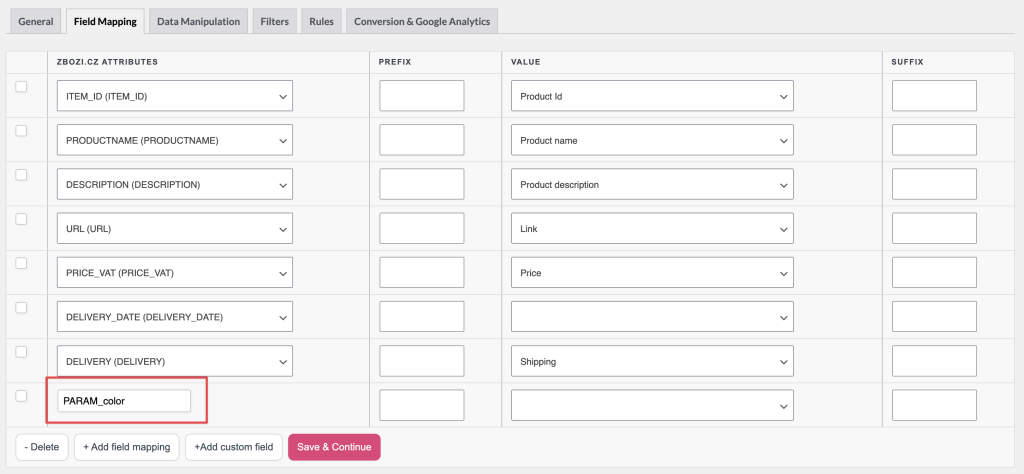
For example, a custom field named PARAM_color mapped to your WooCommerce color attribute outputs this in the feed:
- Yandex:
<param name="color">Red</param> - Zbozi.cz, Heureka.cz, Heureka.sk, Glami.cz, Glami.sk, and Glami.gr:
<PARAM><PARAM_NAME>color</PARAM_NAME><VAL>Red</VAL></PARAM> - Mall.sk:
<PARAM><NAME>color</NAME><VALUE>Red</VALUE></PARAM>
You can add as many PARAM_ fields as your products need. Each one becomes its own <PARAM> block in the feed.
Prerequisites
Before adding PARAMs, make sure you have:
- Product Feed Pro is installed and active
- A feed already configured for one of the supported channels: Yandex, Zbozi.cz, Mall.sk, Heureka.cz, Heureka.sk, Glami.cz, Glami.sk, or Glami.gr, or you’re in the process of creating one
- The relevant product attributes (color, size, etc.) are set up in WooCommerce so they’re available to map
How to add PARAMs to your XML feed
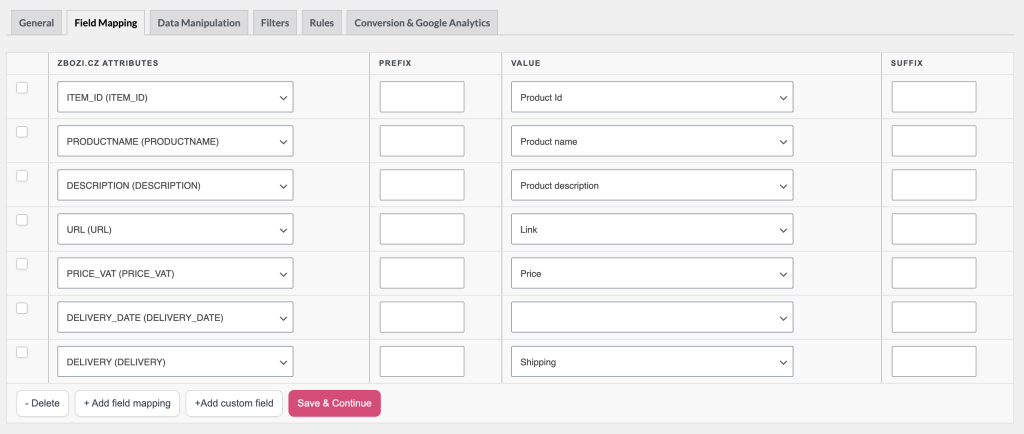
Step 1: Open the field mapping tab
- Go to Product Feed in your WordPress admin menu.
- Open the feed you want to edit (or create a new one for the relevant channel).
- Click the Field Mapping tab.
Step 2: Add a custom field row
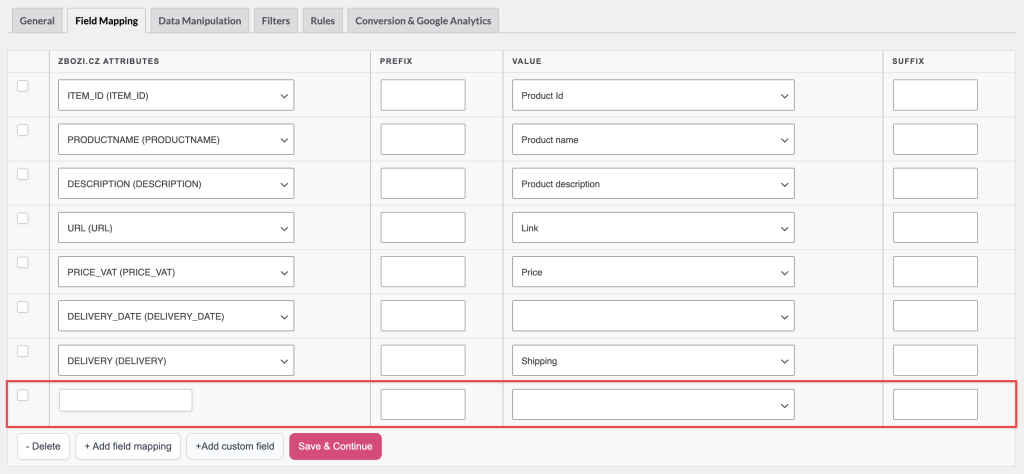
Click + Add custom field at the bottom of the mapping table.
A new row appears with a blank text input on the left side.
Step 3: Name the PARAM field
In the text input, type PARAM_ followed by the parameter name you want in the feed.
Use the exact parameter name the channel expects. For example:
PARAM_colorPARAM_sizePARAM_materialPARAM_brand
The part after PARAM_ becomes the parameter name in the XML output exactly as you type it, so PARAM_Color and PARAM_color produce different XML.
Step 4: Map the field to a WooCommerce attribute
In the Value dropdown on the same row, select the WooCommerce attribute that holds the data for this parameter.
For example, if you want to output the product’s color, select the WooCommerce attribute that stores color data (e.g., Color or pa_color).
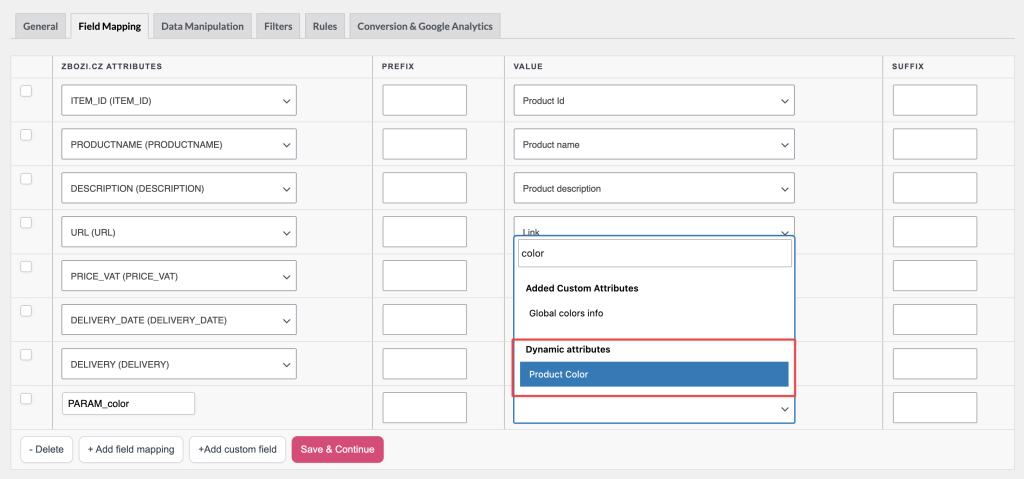
Step 5: Repeat for each parameter
Repeat steps 2–4 for each additional parameter you want to include. Each PARAM_ field you add becomes its own <PARAM> block in the feed.
Step 6: Save your changes
Click Save Changes.
The plugin saves your mapping. On the next feed refresh, all PARAM_ fields output as properly structured <PARAM> elements in the XML.
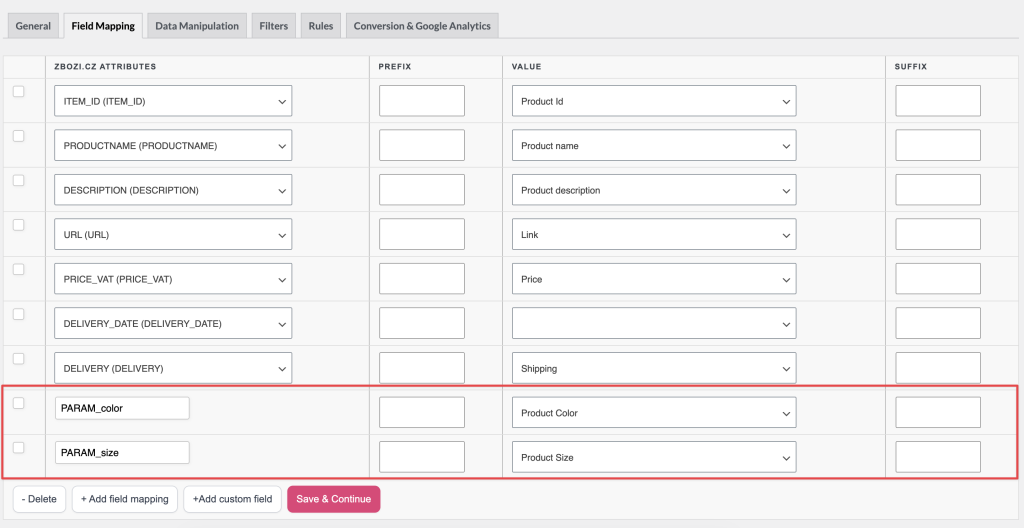
Mall.sk: VARIABLE_PARAMS is handled automatically
Mall.sk feeds include a special VARIABLE_PARAMS field that lists which WooCommerce attributes define product variations (e.g., size, color). The plugin calculates this automatically — it reads the variation attributes directly from WooCommerce.
The VARIABLE_PARAMS field is pre-filled as Plugin calculation in the field mapping table. You don’t need to set it up manually. The XML output looks like this:
<VARIABLE_PARAMS>
  <PARAM>color</PARAM>
  <PARAM>size</PARAM>
</VARIABLE_PARAMS>
Each <PARAM> inside VARIABLE_PARAMS is the name of a WooCommerce variation attribute (with the pa_ prefix stripped automatically). So pa_color becomes color and pa_size becomes size.
XML output reference
The table below shows how a PARAM_color field mapped to the value Red appears in each channel’s feed:
| Channel | XML output |
|---|---|
| Yandex | <param name="color">Red</param> |
| Zbozi.cz | <PARAM><PARAM_NAME>color</PARAM_NAME><VAL>Red</VAL></PARAM> |
| Heureka.cz | <PARAM><PARAM_NAME>color</PARAM_NAME><VAL>Red</VAL></PARAM> |
| Mall.sk | <PARAM><NAME>color</NAME><VALUE>Red</VALUE></PARAM> |
Note that Yandex uses lowercase param with a name XML attribute, while all other supported channels use uppercase PARAM with named child elements.
Troubleshooting
PARAM_ prefix (we recommend typing it in uppercase). Without that prefix, the field is treated as a plain custom field and won’t generate a <PARAM> block. Also confirm the field is mapped to a WooCommerce attribute that has a value for the product, since empty values are skipped.PARAM_ as the parameter name verbatim. Open the Field Mapping tab, find the row, and correct the field name. Save and regenerate the feed.VARIABLE_PARAMS only outputs for variable products. If a product is a simple product (no variations), the block is omitted. Also, confirm the VARIABLE_PARAMS row is present in your field mapping table and set to Plugin calculation.PARAM_ field names accept any characters after the prefix — numbers, spaces, and special characters are all valid. If you’re seeing a validation error, check that your field name begins with PARAM_ exactly (no spaces before or after the prefix).FAQ
PARAM_ row you add creates its own <PARAM> block. If you add PARAM_color twice mapped to different attributes, both appear in the feed. In practice, you’ll only need one row per parameter.PARAM_ prefix also generates correctly structured <PARAM> elements for Heureka.sk, Glami.cz, Glami.sk, and Glami.gr feeds.Need more help?
Product Feed Elite users open a support ticket, and the support team will help you configure your PARAM fields.
Product Feed Pro users, post your question in the WordPress.org support forum, and the team will get back to you there.