

 Reviewed by
AdTribes Product Feed Elite now gives you two new ways to build more focused filters and rules. With In List, you can match multiple values in product feed conditions by entering them as one comma-separated list. With Between, you can match numeric values that fall within a minimum and maximum.
This makes it easier to target a hand-picked set of product IDs, SKUs, or other exact field values without creating a separate condition for each one. You can also cover a complete price, stock quantity, or weight range with a single row.
In this guide, we’ll show you how both conditions work in the Filters and Rules builders, then walk through how to set up each one.
How The New In List And Between Conditions Work
In List and Between appear in the middle dropdown of each condition row, alongside options such as Contains, Equals, and Greater Than. Each one checks whether a product matches the values you enter.
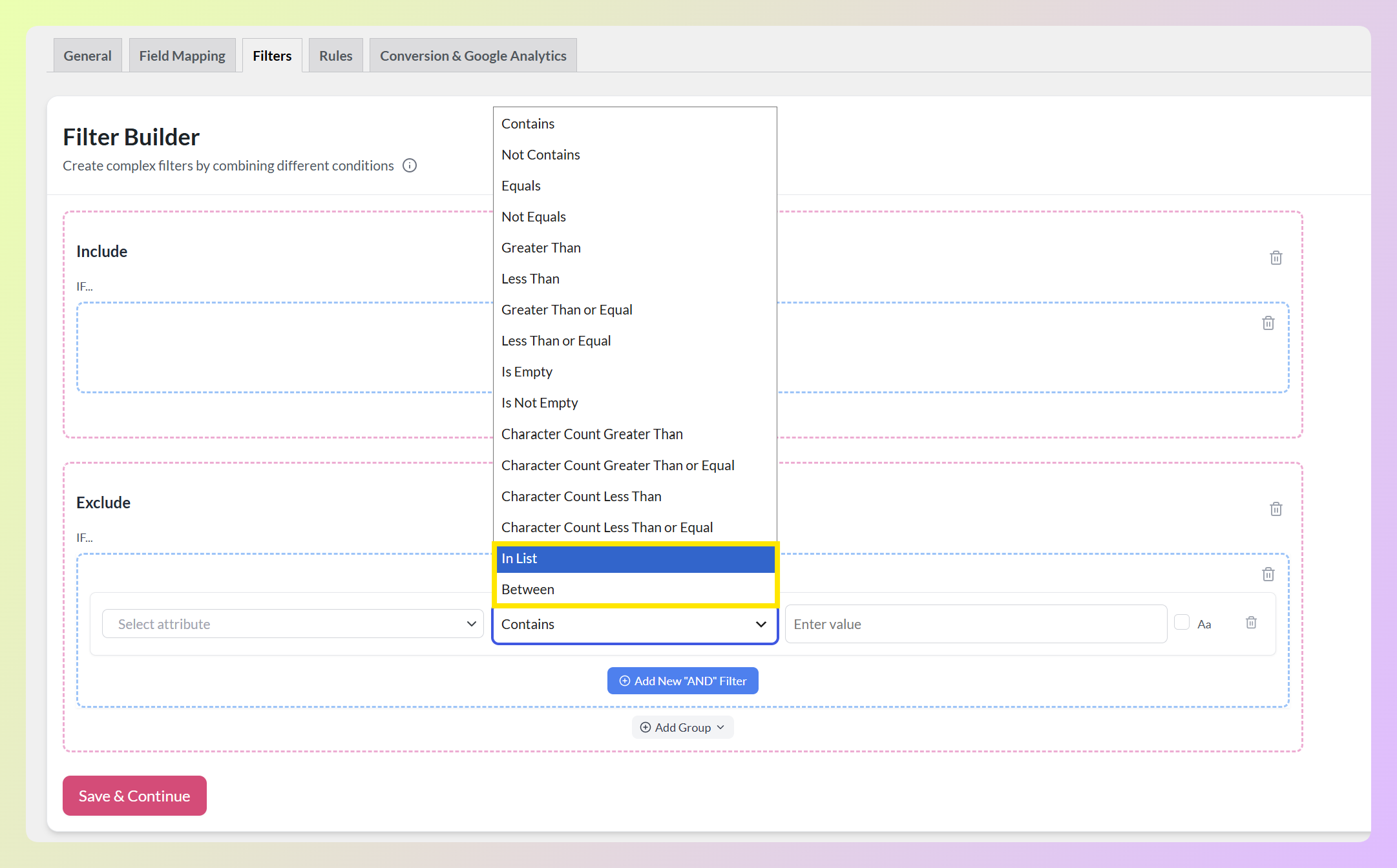
- In List matches when your chosen field equals any value in a comma-separated list you type.
- Between matches when a numeric field falls inside a range you set.
Both conditions help you avoid stacking several similar rows. In List replaces repeated exact-match conditions with one comma-separated list, while Between covers the lower and upper ends of a numeric range in one condition.
How the value box works
The condition row keeps the same layout, with one value box for your entry. In List uses the familiar Enter value prompt.
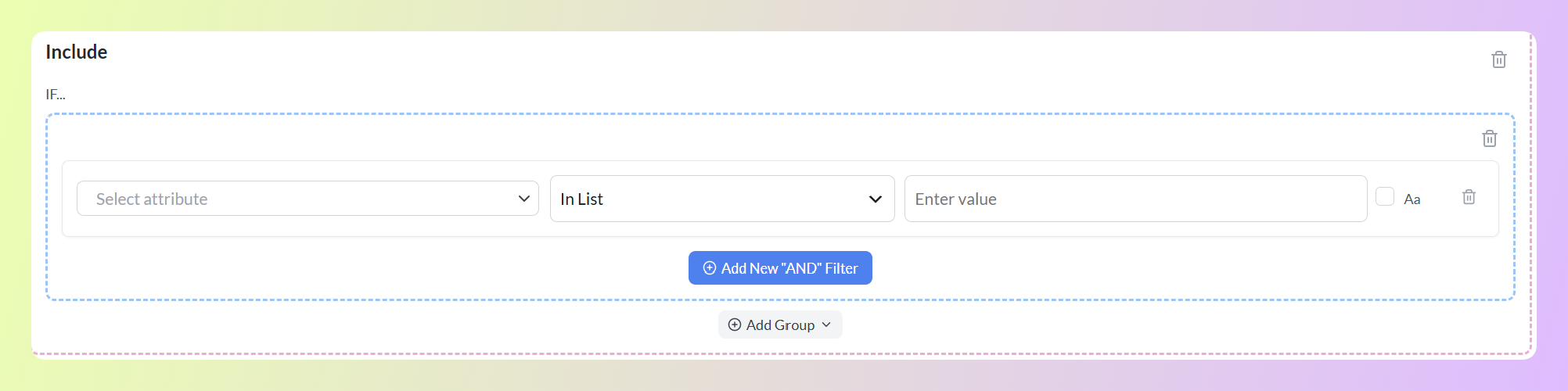
Between shows Min,Max (e.g., 100,200) to make the required format clear.

For In List, separate each value with a comma. Between expects two numeric values: the minimum and maximum of the range. Extra spaces around the entries are ignored, so 101, 245 , 389 works the same as 101,245,389.
Where you can use them
Both conditions are available in the Filters and Rules tabs. The difference is what happens when a product matches:
| Where you use it | What the match decides |
|---|---|
| Filters tab | Whether the product is included in or excluded from the feed. |
| Rules tab | Whether the selected THEN action runs for that product. |
Say you’re running a promotion on a hand-picked group of products. In the Filters tab, an In List row containing those product IDs can limit the feed to that group. In the Rules tab, the same condition can apply a selected action only to those products.
Both conditions are available with all Product Feed Elite plans: Growth, Plus, and Business.
How To Match A List Of Values With In List
Let’s start with a feed that should only contain a particular set of products. Head to your WordPress dashboard > Product Feed, click Edit on the feed you want to work on, and open the Filters tab.
The Filter Builder has separate Include and Exclude sections. Include controls which products can enter the feed, while Exclude removes products that match its conditions. Each section has its own IF area, and you can add conditions with Add New “AND” Filter.
Add a row in the Include section, choose the attribute you want to match on, then pick In List from the condition dropdown. In this example, we selected Brand.
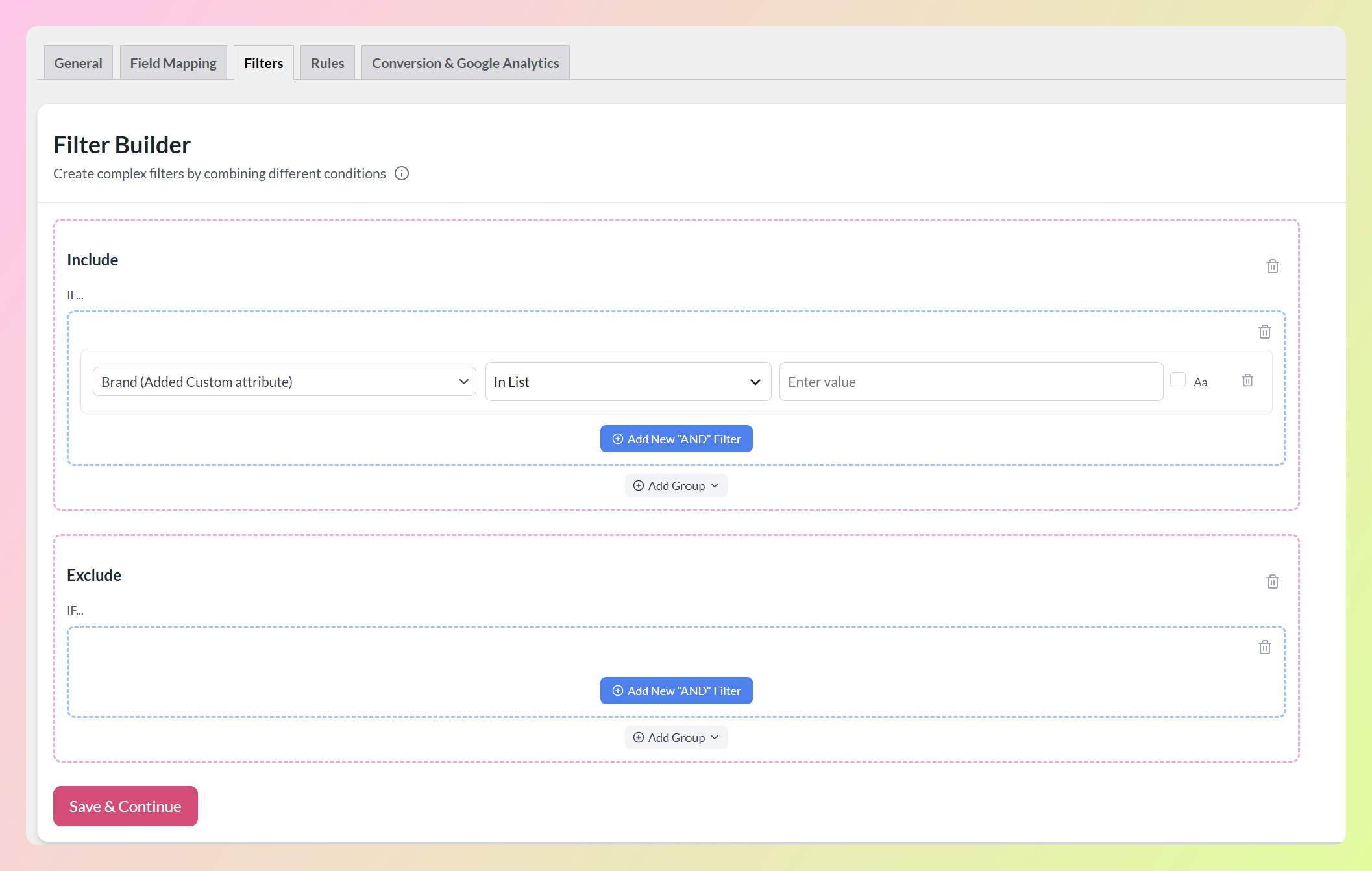
Now type the brand names into the Enter value box, separated by commas. In our example, we entered Nike,Adidas,Puma.
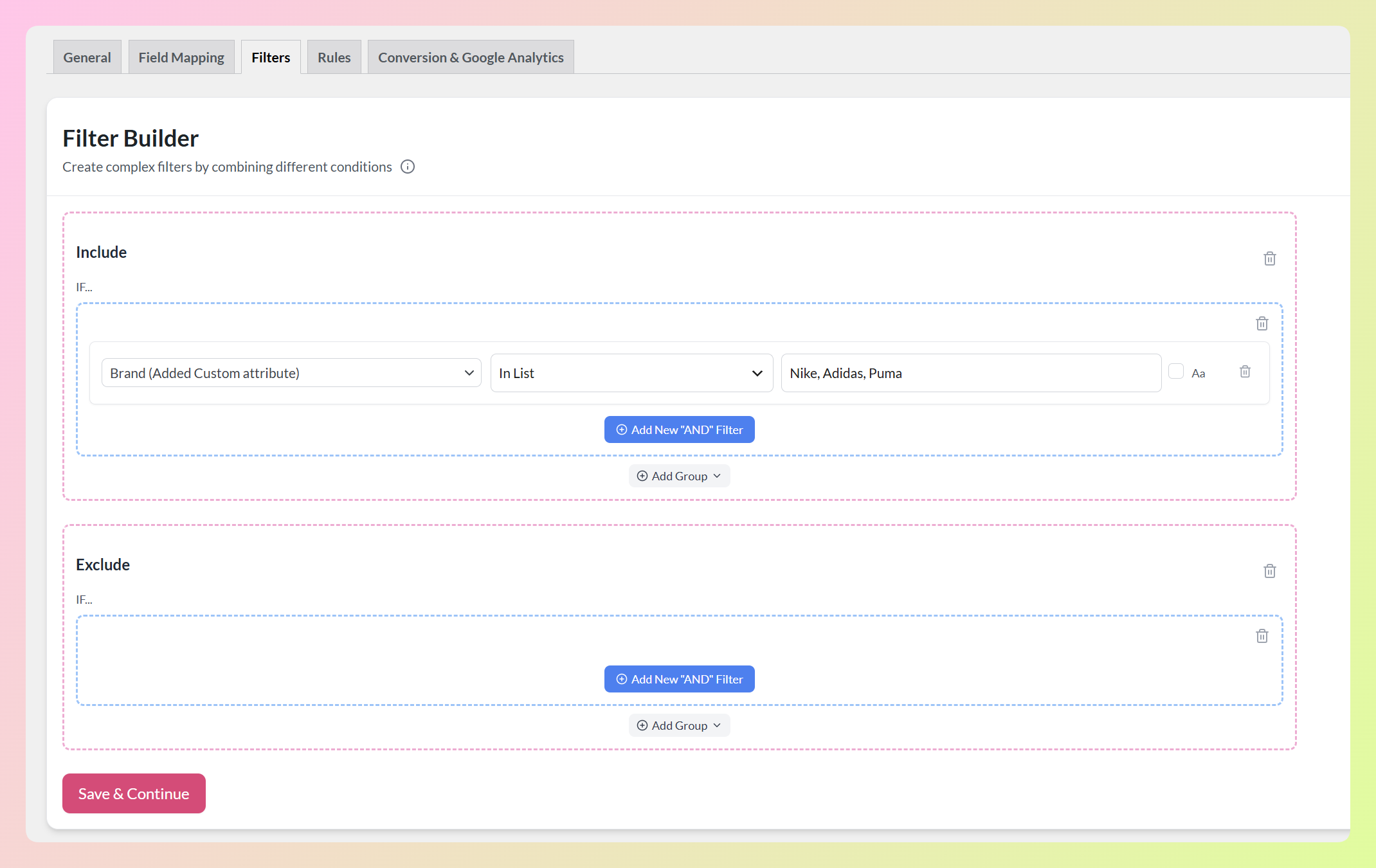
The completed row reads Brand, In List, followed by the three brands we want to target. Products with a matching Brand value satisfy this Include condition.
In List checks each entry as a complete value rather than a partial match. For example, Nike matches a Brand value of Nike, but it will not match a longer value that only contains the word. For partial matching, use Contains. The Aa checkbox at the end of the row controls case sensitivity.
You can use In List with any available attribute, not just Product ID. It is especially useful for fields with clear values you want to match exactly, such as product IDs, SKUs, or brand names.
🎯 POWER TIP: In List also works in the Exclude section. For example, you can enter several brand names in one row when you want to leave all of those brands out of a particular feed.
The same condition is available on the Rules tab, where you can use it to decide which products a THEN action applies to. There, the button reads Add New “AND” Condition, but the condition row works the same way.
How To Match A Number Range With Between
Between follows a similar setup, but it is designed for numeric ranges instead of lists of exact values. In the Include section of the Filters tab, add a new filter and choose the numeric attribute you want to use. For this example, we selected Price. Then choose Between from the condition dropdown.
The value box now displays Min,Max (e.g., 100,200), showing the format the condition expects. Enter the minimum and maximum values separated by a comma.
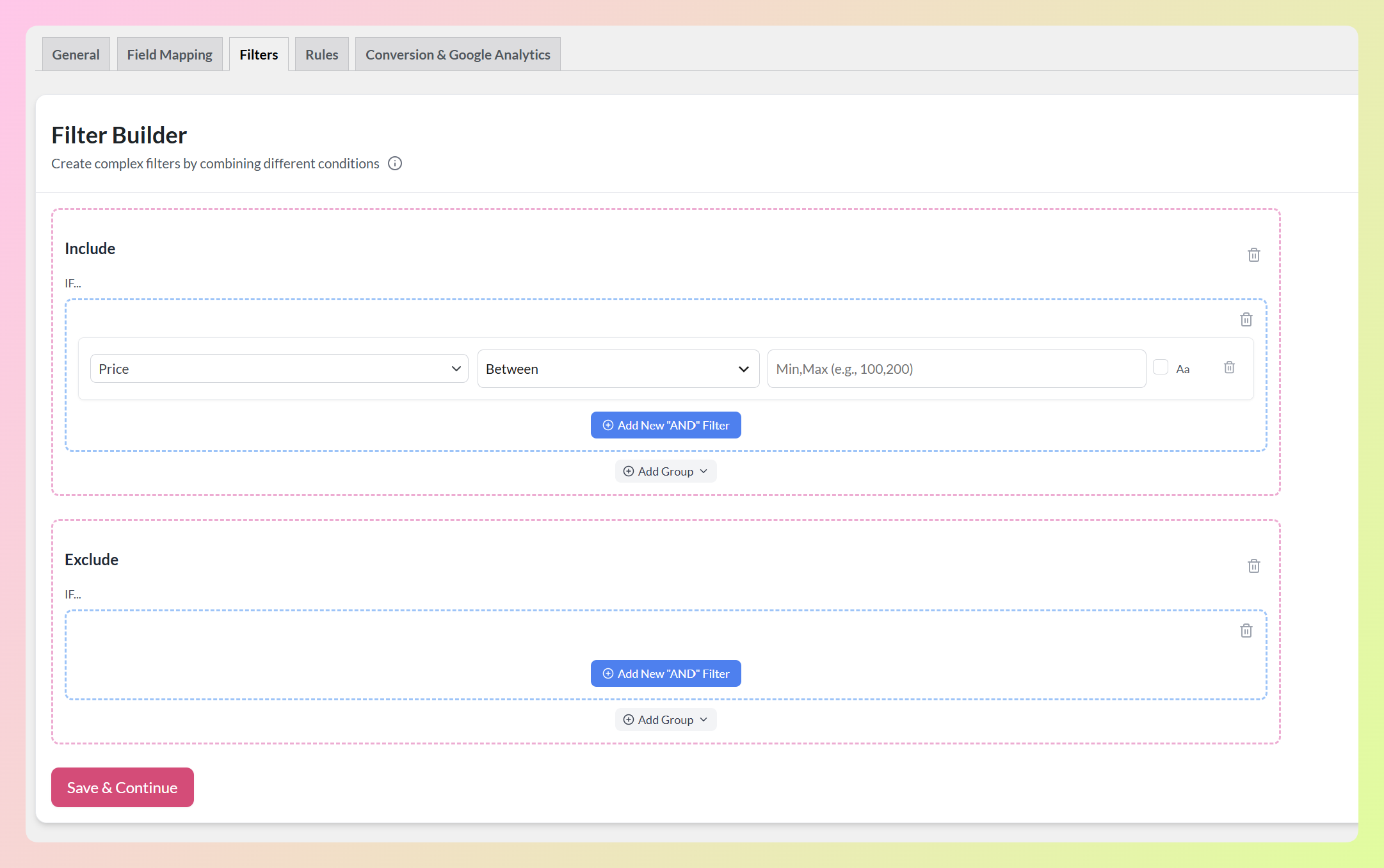
In our example, we entered 100,200. The completed row reads Price, Between, and 100,200.
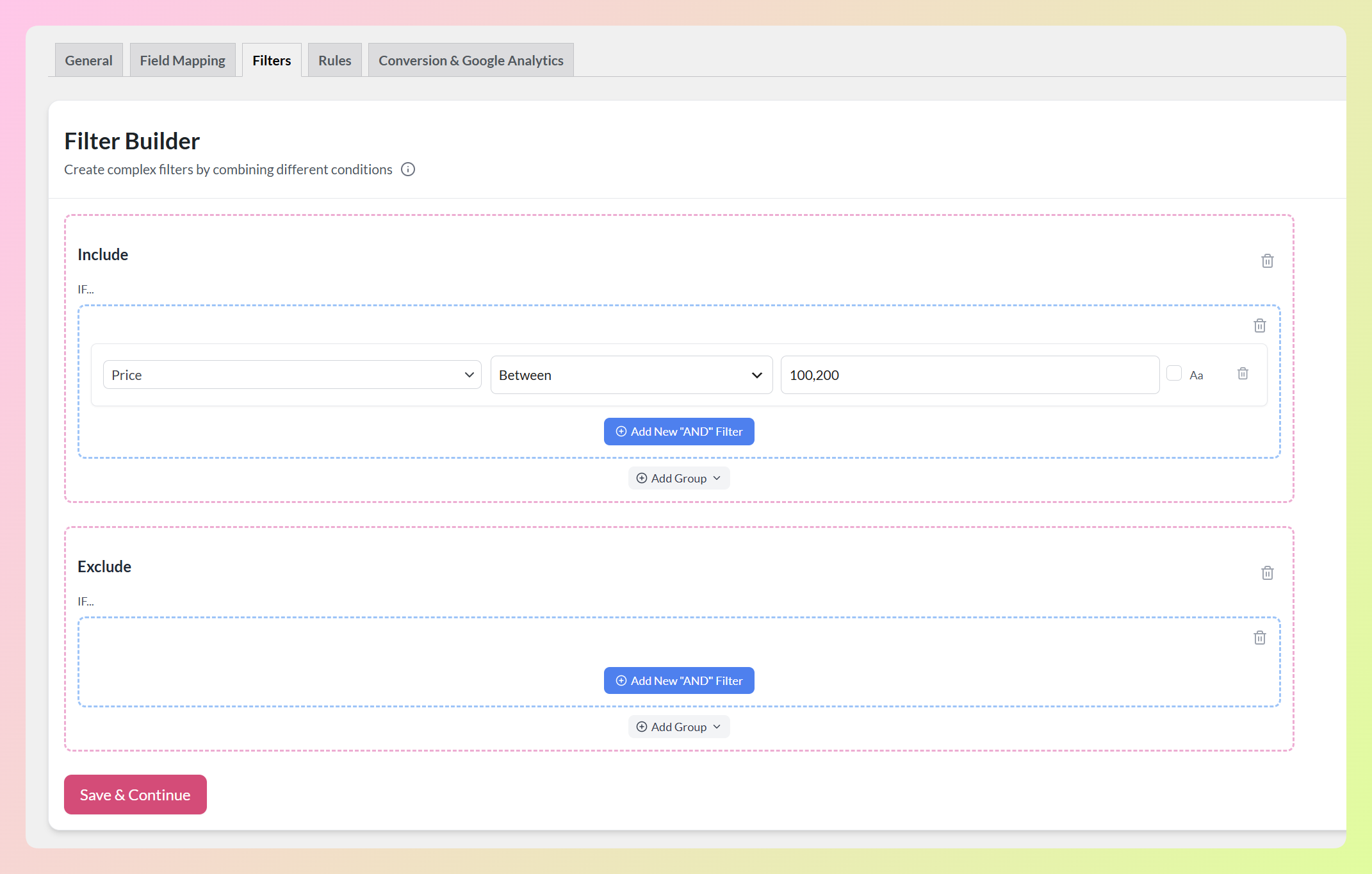
Products priced from 100 to 200 satisfy this Include condition, while products outside the range do not. Both ends of the range count as a match, so products priced at exactly 100 or exactly 200 are included too.
You can also use Between with other numeric attributes, such as sale price, stock quantity, or weight. This makes it useful whenever you need to target products within a specific numeric range.
If you enter the larger number first, Between still reads the intended range. For example, 200,100 works the same as 100,200.
Frequently Asked Questions
Can I use In List and Between in both Filters and Rules?
Yes. Both appear in the condition dropdown on the Filters tab and the Rules tab. In Filters, a match decides whether the product is included in or excluded from the feed. In Rules, a match decides whether the THEN action runs on that product.
Can I type a comma-separated list into the Equals condition instead?
Equals compares the whole value exactly as you type it, so a comma-separated list would be treated as one long value rather than several. In List is the one built for matching against a list, so pick it from the condition dropdown and your values will be read as separate entries.
Does In List match partial text?
No, each entry is matched in full. That keeps your lists predictable, since a short entry can’t accidentally match a longer value. If you want partial matching, use the Contains condition instead.
Is the Between condition inclusive of the minimum and maximum?
Yes. Both ends of the range count as a match, so a range of 100,200 includes products at exactly 100 and exactly 200 as well as everything in between.
Which attributes can I use the Between condition on?
You can use Between with attributes that contain numeric values, such as price, sale price, stock quantity, or weight. For matching several exact values instead of a numeric range, use In List.
How many values can I put in an In List condition?
In List does not show a fixed item limit. Add the values relevant to your filter or rule, separate them with commas, and update the list whenever your product selection changes.
Do these conditions change my WooCommerce product data?
No. Filters and rules act on your feed as it’s generated, so they change what your channel receives, not the products stored in your store. They’re also set per feed, so a condition on one feed won’t affect the others.
Wrapping Up
In List and Between make product feed conditions easier to manage. In List matches a set of exact values in one row, while Between covers a numeric range using one minimum and maximum. This keeps your filters and rules easier to scan, review, and update later.
In this guide, we learned:
- How the new In List and Between conditions work
- How to match a list of values with In List
- How to match a number range with Between
With Product Feed Elite 5.1.0, both conditions are ready to use in the Filters and Rules builders. Try In List the next time you need to target several exact values, or Between when you want to cover a numeric range.
Do you have any questions about this update? Let us know in the comments. Happy to help!