Reviewed by
Should you use ACP or UCP for your WooCommerce store? You don’t have to choose just one. These agentic commerce protocols help AI shopping platforms work with merchants, but preparing a product feed and enabling checkout are two different steps.
Between technical requirements, checkout options, and merchant applications, it can be hard to tell what you can set up yourself and what depends on each platform.
Here’s how OpenAI’s Agentic Commerce Protocol (ACP) and Google’s Universal Commerce Protocol (UCP) compare, and where WooCommerce product feeds fit into each.
What Is An Agentic Commerce Protocol? (Quick Answer)
An agentic commerce protocol sets common rules for how AI shopping services and merchants exchange information. It can support product discovery, carts, and checkout, depending on the integration. A product feed helps an AI platform understand what you sell, while checkout requires additional setup. The merchant remains responsible for its sales and customer relationships.
Two protocols matter most to store owners right now:
- ACP (Agentic Commerce Protocol): Built by Stripe and OpenAI, and first used for checkout inside ChatGPT.
- UCP (Universal Commerce Protocol): Built by Google for checkout on eligible listings in AI Mode in Google Search and in Gemini.
For background on the agents themselves, see our guide to getting your store ready for AI shopping agents.
OpenAI’s Agentic Commerce Protocol (ACP) In Brief
ACP is an open standard developed by Stripe and OpenAI. As Stripe explained when it was announced on September 29, 2025, ACP first powered Instant Checkout in ChatGPT. In March 2026, OpenAI shifted its shopping focus toward product discovery and merchants’ own checkout experiences.
For merchants, the Agentic Commerce Protocol has a few important features:
- Open source: ACP is open source and community-designed under the Apache 2.0 license.
- ChatGPT first: OpenAI is the first AI platform to use ACP.
- Feed access: OpenAI currently onboards product feeds from approved partners. Creating a feed doesn’t automatically list your products in ChatGPT.
- Your payment provider: For checkout integrations, ACP supports compatible payment providers. Stripe was the first, using its Shared Payment Token.
- Your customer: You stay the merchant of record and decide which products are sold and how orders are fulfilled.
For the shopper’s side of the experience, read how ChatGPT Shopping works.
What ChatGPT reads from your store
ChatGPT can use structured catalog data, including product titles, images, prices, and availability, to help shoppers discover products. Merchants share that information through an OpenAI product-feed integration.
That catalog data comes from a product feed. You can build a free OpenAI product feed for WooCommerce with AdTribes, then follow OpenAI’s onboarding process to request access.
Google’s Universal Commerce Protocol (UCP) In Brief
UCP is Google’s open standard for agentic commerce, covering the whole journey from discovery and buying to post-purchase support. Google announced UCP on January 11, 2026. Google co-developed it with retailers including Etsy, Wayfair, Target, and Walmart, and more than 20 other companies endorsed it, among them Adyen, American Express, Best Buy, Mastercard, Stripe, and Visa.
UCP supports checkout on eligible product listings in AI Mode in Google Search and in Gemini. It also supports transferring a shopper’s cart to the merchant’s website, depending on the integration.
ACP Vs UCP: Side-By-Side Comparison
ACP and UCP both help AI shopping experiences work with merchants. OpenAI uses ACP to support product discovery in ChatGPT, while Google uses Merchant Center feeds for discovery and offers UCP integrations for checkout on Google or transferring a cart to the merchant’s website. A product feed alone doesn’t enable either checkout path.
Here’s how the two compare from a store owner’s perspective:
| OpenAI Agentic Commerce Protocol (ACP) | Google Universal Commerce Protocol (UCP) | |
|---|---|---|
| Built by | Stripe and OpenAI | Google, co-developed with retailers including Etsy, Wayfair, Target, and Walmart |
| Announced | September 29, 2025 | January 11, 2026 |
| Where shoppers see you | ChatGPT | AI Mode in Google Search, Gemini |
| Current access requirements | Product-feed onboarding for approved partners (discovery) | UCP checkout for select merchants; Merchant Center integration starts in the US, with Canada and Australia to follow |
| Payments | Compatible payment providers for ACP checkout; Stripe first | Google Pay with saved Google Wallet details for UCP checkout |
| Merchant of record | You | You |
| Product data you supply | Structured catalog data (a product feed) | Your existing Merchant Center shopping feeds |
| What a feed plugin covers | The product feed (AdTribes OpenAI channel, free) | The Merchant Center discovery feed (AdTribes Google Shopping feed), not UCP checkout |
Who runs the checkout and payments
ACP’s checkout design supports compatible payment providers, with Stripe as the first implementation. For Google’s UCP-powered checkout, Merchant Center Help explains that eligible shoppers use Google Pay with details saved in Google Wallet. The merchant remains the seller of record.
How a merchant gets in
Product discovery and checkout have different requirements. OpenAI currently accepts ACP product feeds from approved partners. Google Merchant Center feeds can support product discovery, but UCP-powered checkout is available only to select merchants. Creating either feed in AdTribes doesn’t automatically enroll your store in a checkout program.
Where shoppers see you
ChatGPT uses product-feed data for discovery, while Google’s AI shopping surfaces can show eligible items from Merchant Center. AdTribes can generate feeds for both from one WooCommerce catalog. Their core fields overlap: title, description, link, image, price, and availability.
OpenAI’s standard discovery feed requires an item ID, title, description, product URL, image URL, price, availability, brand, and seller name. Other fields, such as seller_url, return_policy, target_countries, store_country, and is_eligible_checkout, are optional or conditional depending on the integration. You can check the OpenAI product-feed specification for the full requirements. For Google, add the feed URL as a file source under Settings > Data sources in Merchant Center and set its fetch schedule.
How These Protocols Relate To MCP, A2A And AP2
ACP and UCP focus on commerce, while MCP, A2A, and AP2 address other ways that agents connect, communicate, and handle payments. Google’s UCP overview says UCP is compatible with all three:
- MCP (Model Context Protocol): Connects AI clients to tools and actions, such as a plugin’s features.
- A2A (Agent2Agent): Lets AI agents communicate with other agents.
- AP2 (Agent Payments Protocol): Covers how agents handle payments.
You don’t need to set up MCP, A2A, or AP2 just to generate product feeds for ChatGPT or Merchant Center. Participating in checkout programs involves separate technical steps. For a WooCommerce example of MCP-connected feed management, see how to manage product feeds with AI via the WordPress Abilities API.
What Store Owners Should Prepare For AI Shopping
A useful first step for either shopping channel is accurate, complete, and current product data. Titles, descriptions, prices, availability, images, product identifiers, and shipping details help platforms understand what you sell. Checkout participation has additional requirements beyond that data.
Google uses existing Merchant Center shopping feeds for product discovery. ChatGPT uses structured product feeds as well, but each platform has its own data requirements and onboarding process.
Here’s a practical product-feed checklist for preparing for agentic commerce:
- Complete titles and descriptions: Describe the product in the words a shopper would use.
- Correct identifiers: Add GTIN, MPN, and brand wherever your products have them.
- Current price and stock: Keep the feed in line with the product page.
- Clear policies: Keep your return policy and shipping details accessible, and include policy information where your feed setup requires it.
- Regular refreshes: Update often enough that stock and sale changes reach each channel.
Start With Your Feed: Before focusing on checkout, check for missing product identifiers, outdated stock information, and prices that don’t match your product pages. These gaps can affect how products are matched and displayed in AI shopping experiences. Get your catalog data in shape first.
How AdTribes Keeps Your Catalog Ready For Both
AdTribes Product Feed Pro is a free WooCommerce product feed plugin that turns your catalog into feeds for Google, ChatGPT, and other channels. It covers the product-data layer of agentic commerce, which is the part you control.
For the product-feed side of AI shopping, AdTribes offers:
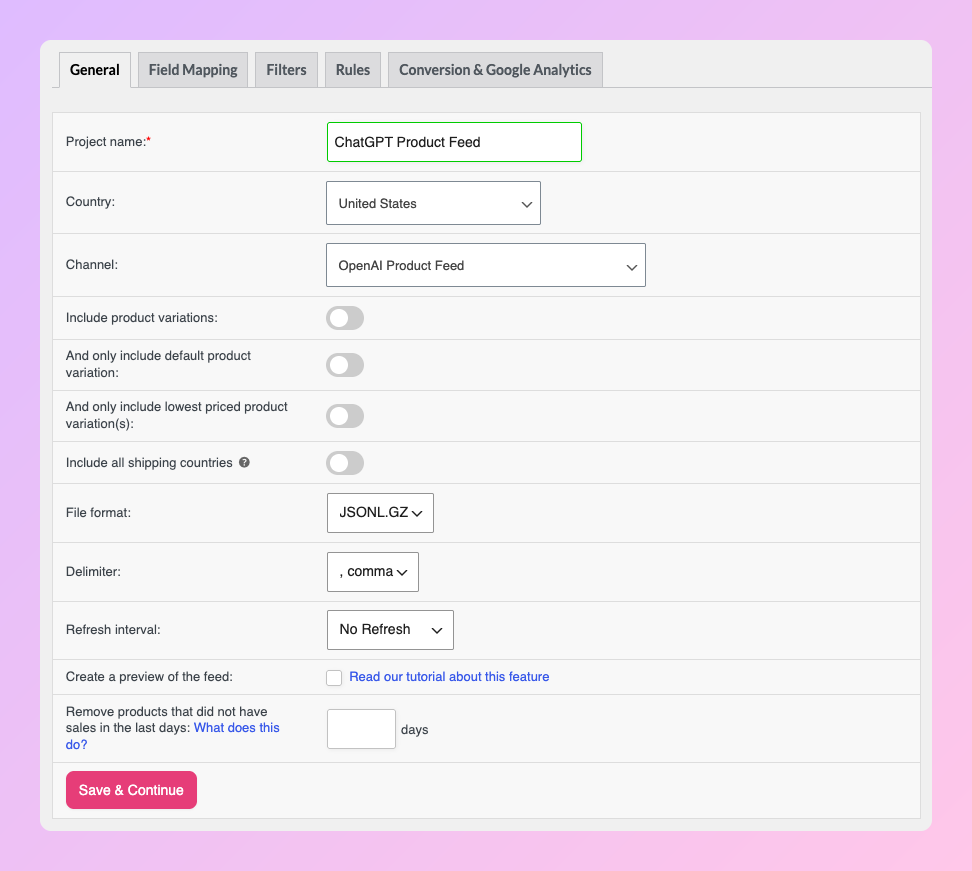
- A free OpenAI channel: AdTribes Product Feed Pro includes an OpenAI product feed channel, so you can build a ChatGPT feed without a paid plan.
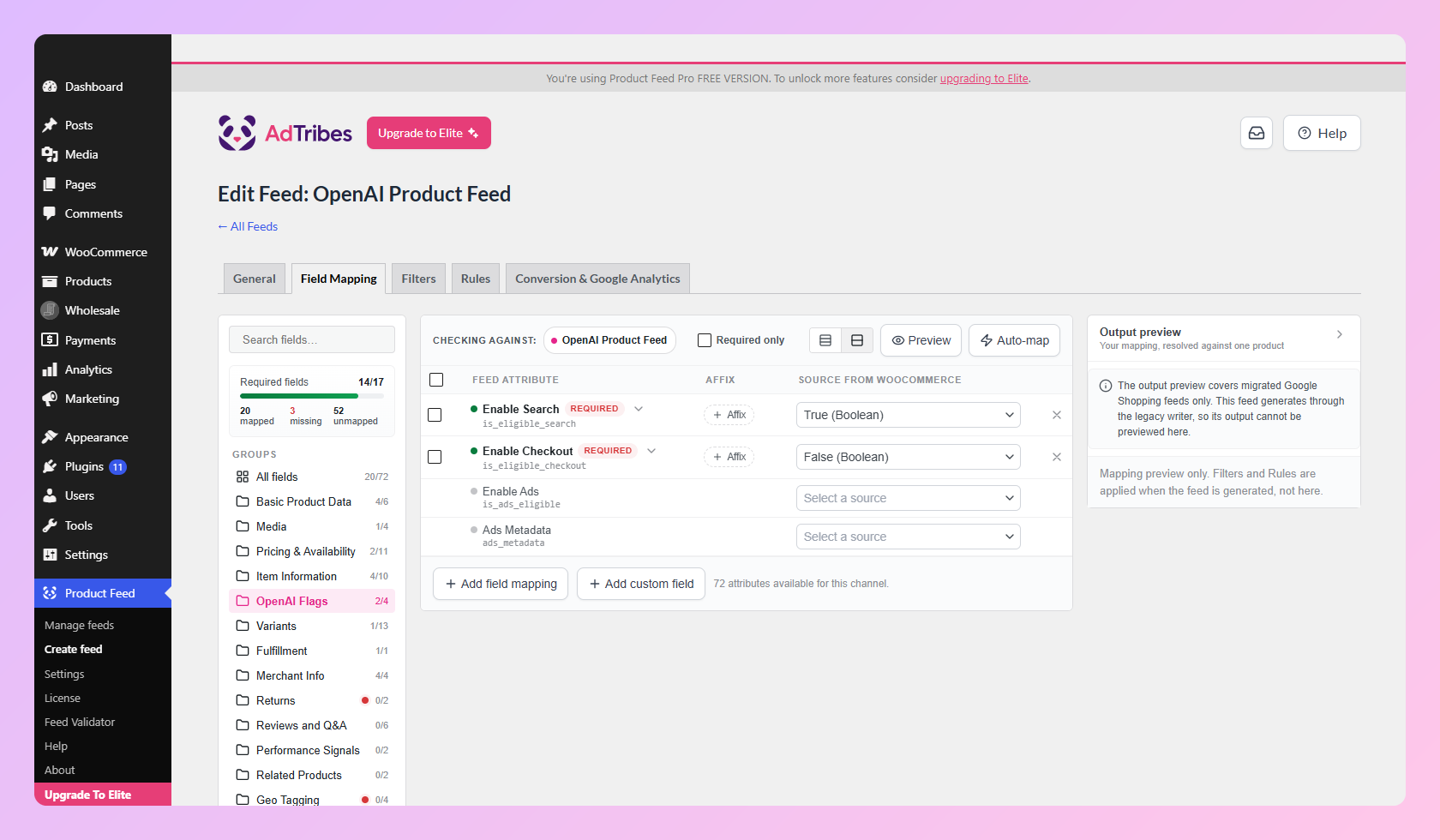
- Eligibility flags: Under OpenAI Flags, you can map
is_eligible_search,is_eligible_checkout, andis_ads_eligible. These flags communicate product eligibility settings but don’t activate checkout or advertising on their own. - A Google Shopping feed: AdTribes generates a feed URL that Merchant Center can fetch on a schedule. This helps you keep Google’s product-discovery data updated, while the accuracy and completeness of the feed still depend on your WooCommerce catalog and field mappings. UCP checkout requires a separate integration.
- Mapping, filters and rules: Field mapping, Google category mapping, include and exclude filters, and IF/THEN rules all come with the free plugin.
- Refresh schedules: Pick daily, twice daily, or hourly refreshes for free. Custom intervals need Product Feed Elite.
- Feed Validator: On the Plus and Business plans of Product Feed Elite, the Feed Validator checks live feed URLs, OpenAI feeds included.
On the OpenAI feed, AdTribes suggests a mapping with Enable Search on and Enable Checkout off. That’s a sensible starting point for product discovery, since a checkout-eligible flag doesn’t enable checkout by itself. You can change either flag before generating the feed.
For Google, you copy the AdTribes feed URL and add it in Merchant Center as a file-based product source with a fetch schedule.
To set up either feed, start with the OpenAI product feed for WooCommerce and the Google Shopping product feed.
Frequently Asked Questions
Do I have to choose between ACP and UCP?
No. You can prepare product feeds for ChatGPT and Google at the same time. One well-maintained WooCommerce catalog can supply both an OpenAI product feed and a Merchant Center feed, but each platform has its own onboarding and checkout requirements. A feed doesn’t guarantee placement or enable checkout.
Is agentic commerce available to WooCommerce stores today?
Partly. Any WooCommerce store can create product feeds for ChatGPT and Google Merchant Center. OpenAI currently onboards product feeds from approved partners. Google limits UCP-powered checkout to select merchants, with its Merchant Center integration rolling out in the United States first and Canada and Australia to follow. Merchant Center product discovery and UCP checkout are separate.
Do I need a developer to use ACP or UCP?
You don’t need a developer to prepare your product data. AdTribes Product Feed Pro can build OpenAI and Google Shopping feeds from your WooCommerce catalog without code. Participating in an in-platform checkout program is separate and may require approval, technical integration, and help from your payment provider or a developer.
Does my product feed matter for AI shopping agents?
Yes. OpenAI uses structured product data to understand and display products in ChatGPT, while Google uses Merchant Center feeds for product discovery. Missing required information, outdated stock, or mismatched prices can affect how products appear. Preparing a feed is important, but it doesn’t enable checkout on its own.
Is ACP the same as MCP?
No. ACP is a commerce protocol for shopping and checkout flows between shoppers, AI agents, and businesses. MCP (Model Context Protocol) is a general standard that connects AI clients to tools and actions. Google says UCP is compatible with MCP, alongside A2A and AP2, but each protocol does a different job.
Get Your WooCommerce Catalog Ready For Agentic Commerce
You can’t control when AI shopping platforms open new features to merchants, but you can keep your WooCommerce catalog ready. Accurate titles, prices, stock details, and product identifiers give you a stronger starting point for the channels you choose to join.
Your next steps:
- Learn how ACP works and what OpenAI’s product-feed onboarding involves.
- Compare ACP and UCP side by side to decide which surfaces you want to be on.
- Improve the data both shopping channels use, starting with identifiers, prices, and stock.
- Build your feeds with AdTribes for ChatGPT and Merchant Center.
Start with a free OpenAI product feed for WooCommerce in AdTribes. You can review your catalog data and keep the feed updated while you work through OpenAI’s onboarding requirements.